


Fetal Alcohol Spectrum Disorder (FASD) affects an estimated 1 in 20 people, making it more common than autism, yet it remains one of the most underrecognized developmental disabilities. FASD is not a healthcare problem, an education problem, or a justice problem. It is a cross-systems disability that touches nearly every public system. Across California, individuals with FASD interact with healthcare, education, mental health, child welfare, disability services, housing, employment, and justice systems. Support is already being provided through these systems, but too often it is not adapted to the brain-based challenges associated with FASD.
.jpg)
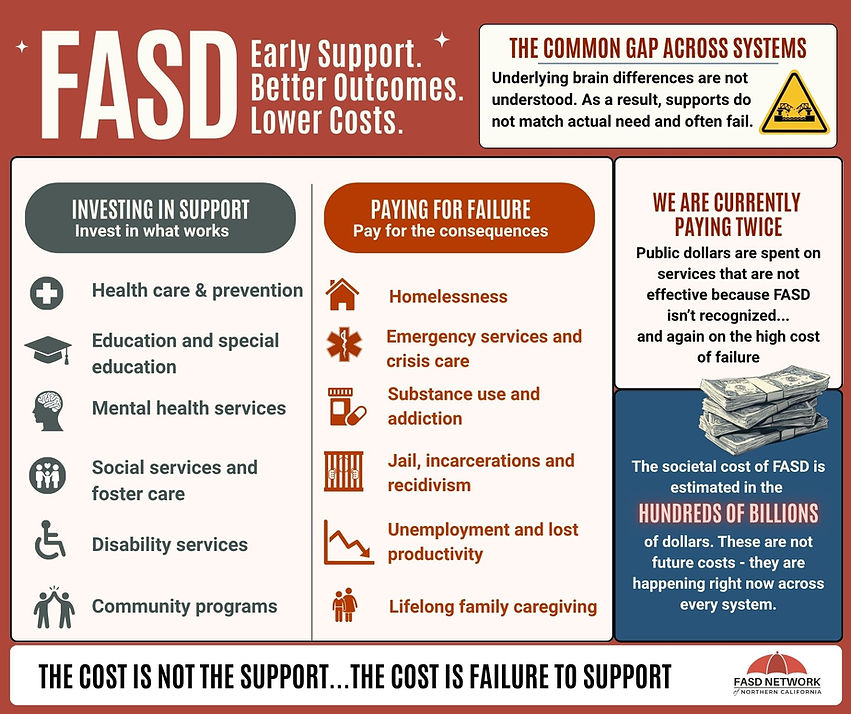
The result is a costly cycle. Public dollars are spent on services that may be ineffective because the disability is not recognized or understood. When needs remain unmet, additional costs appear across other systems through school failure, mental health crises, homelessness, substance use disorders, unemployment, incarceration, and lifelong family caregiving. We end up paying for support and paying again for the consequences when support does not match need.
Research reviewed in California's FASD policy work estimates that the societal cost of FASD reaches into the hundreds of billions of dollars. These costs are not driven by the disability itself, they are driven by missed opportunities for identification, intervention, and appropriate support. The challenge is not a lack of services. The challenge is ensuring that services match the disability.
Early identification, FASD-informed assessment, professional training, and coordinated services can improve outcomes while reducing long-term costs. The question is not whether we will pay. The question is whether we invest in effective support—or continue paying for preventable failure.